Having a family as large as ours meant that every other year a Carty was in the kindergarten class at Ernie Pyle Elementary School, located a straight shot four miles west of Summit Grove. The school was named for Ernie Pyle, an American journalist and World War II correspondent who was born in nearby Dana, Indiana.
The school was in the middle of farmland, serving families from Dana, St. Bernice, Fairview, and smaller nearby towns like Summit Grove and Hillsdale.
By the time I showed up at Ernie Pyle, I was the fifth Carty kid to attend. I followed my half-brothers Ricky and Danny, who probably only attended grades 6-8. And those three grades were probably the best seven years of their lives. Once they finally reached high school, they both dropped out and joined the military.
Also preceding me were Dick and Lynn. Four grades ahead of me, Dick was a good student, but Lynn was just two years before me, so the teachers were sure to compare us. I think Lynn would be the first – or maybe the second – to admit that her focus in school was never education; it was more social. She had a lot of friends, and the teachers liked her, but when I showed up in their class, there was no high academic bar set for me.
Plus, I had a pretty noticeable speech impediment, which included the inability to pronounce “R” sounds. Ironically, this is called rhoticism. (I mean WHY does it have to start with the sound we can’t say?!) Like Elmer Fudd, I pronounced R’s as W’s, but I wemember not being able to hear myself do it, so I wasn’t weally embawassed.
Whether I could hear it or not, my impediment was so severe that later in life, our principal, Mr. Nelson, shared with my older brother Dick that he thought I was “special needs” when I came to kindergarten.
After college, Dick was a teacher, and he ran into Mr. Nelson at a conference. Since there was a seemingly never-ending stream of Cartys in the school during his tenure as principal, he asked about Dick’s siblings.
When he got to me, he asked, “How about your sister, Dyann?”
“She’s a graphic designer and living in St. Louis.”
“That’s amazing! You know I thought she was retarded when she started kindergarten.”
Nice, right? So much for confidentiality and using the right terms.
The truth hurts. And the truth is that all my younger siblings had the same speech impediment and required speech therapy. Some of our cousins said we spoke “Dutch.” Just a little nicer than “retarded.”
I think I was in second grade when our school got a speech therapist, and after being screened, I was among those scheduled to be pulled out on a regular basis for speech therapy. This is when I got extremely embarrassed because I felt a lot of the other kids who were identified for speech therapy were slower learners. I was a good student. What was going on here?
My mom was no help at all. She offered to go talk to the school and say, “I don’t know why you think she doesn’t talk wight.”
“Weally, Mom?”
I’m pretty sure I set the speed record for speech therapy graduation. By the next year, I was released and could pronounce my R’s so well it was Really Rather Remarkable.
I Can See Clearly Now
Just like with my speech impediment, I had no clue that I was blind as a bat. I have no idea when I started not being able to see clearly, but I do remember the day it became obvious to others.
During my fifth-grade year, I was about a football field length up the railroad tracks from Summit Grove with my brother Dick, when he looked towards the road crossing. “There’s Mom getting home,” he told me.
I looked up and squinted and said, “I don’t see her.”
“What?! You have to be kidding! The car is right there!” he almost scolded me.
We headed back to the house, and he grabbed my hand and pulled me into the kitchen to confront our mother, who was putting away groceries. It must have been a Thursday. Mom got paid on Thursdays.
“Dyann couldn’t see you crossing the tracks, Mom. She’s blind!” he proclaimed.
I admitted that I had been moved to the front row of my class so I could see the blackboard. This sparked a series of questions to test me, with Mom asking me, can you see this and that. And, of course, I couldn’t see this or that.
I couldn’t read the name of the cereal she was putting away. How could this be happening? No one in our family wore glasses except our grandparents, and they are old! Our dad was a sharp-shooting hunter and pool player, and Mom also had perfect vision for all her mom duties.
The next day Mom made an appointment for me to see an optometrist, and a pair of glasses was ordered. I felt terrible. We could barely afford the boxes of cereal I couldn’t read. Plus, Mom had to take time off from work to take me twice. First for the exam, then to pick up my new glasses.
Just the year before, when Mom was working the evening shift, my brother Dick hadn’t told her about his 8th grade graduation because he didn’t think she could afford to miss work. He bummed a ride with our neighbor and didn’t breathe a word about it.
When Mom saw the program from the ceremony the next day, she asked Dick why he hadn’t told her. He simply said, “I didn’t think you could get off work for it.” Mom cried a little over that. And she switched to day shift.
And here was selfish, blind me causing Mom to miss work, not once but twice, just so I could see. Even so, I was a typical kid, so the day we picked up my glasses, I was more worried about looking ugly or stupid in them than being a financial burden.
In the car on the way back to school, I was amazed at all the details in the world I had been missing. “Wow, Mom! I can read that license plate! I can see the leaves on the trees!” Mom cried a little over that, too.
As we neared the school, it suddenly started raining really hard, and then, just as suddenly, it stopped. Mom switched off the wipers, looked up at the sky, and said, “Well, that was just a little cloudburst.” I had never heard such a perfect, descriptive word. My mom’s tears are a lot like cloudbursts, I thought.
Mom dropped me back off at school, and as I walked down the hall toward my class, a very cute seventh-grade boy was standing outside his classroom. He was most likely waiting to get his butt paddled for some minor rule infraction. This was the 70s, after all.
“Cute glasses!” this dashing delinquent said to me, a mere fifth grader. And just like that, I forgot all about the financial burden I had just brought to my family and proudly walked to the end of the hall into my own class.
As my classmates’ heads turned, I smiled brightly because I had “cute glasses,” and I could see the blackboard from the back of the room.
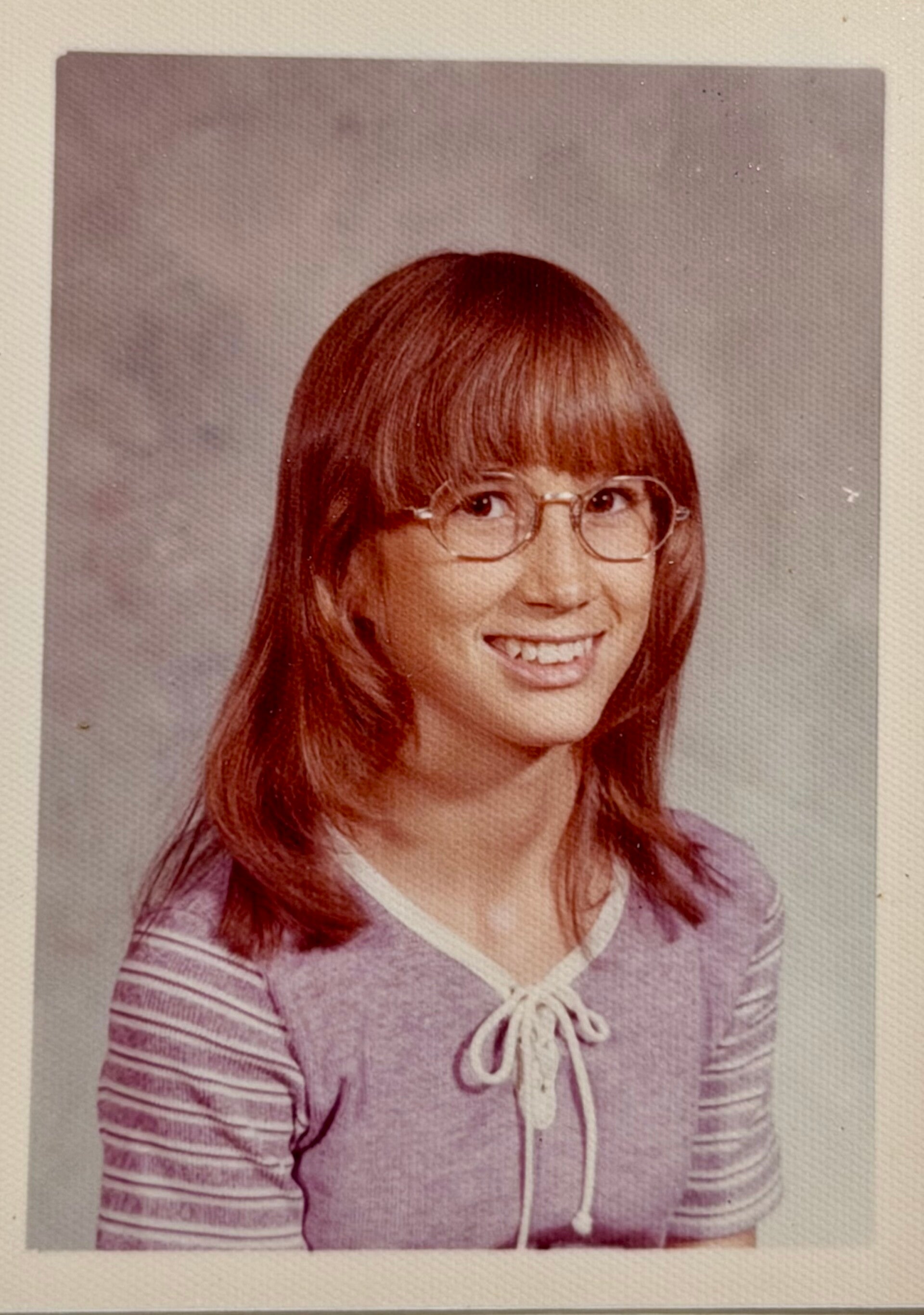
This is my fifth-grade class picture in my new glasses. I had these same frames until high school.
Add comment
Comments
I love this one so much! And the picture… ❤️
weally weally good one
Whoa, whoa! I could say my R's. I wasn't widiculous like you. I couldn't say my S's. Yoursh wash sho worshe than mine. You losher!
Who knew someone who’d conquered all your problems could write? You really can. I will now try to faithfully read your amusing writings.
The impediment came from your father's side. Jody also had one as a child. Also one of the few times my father cried is when I proclaimed "I can see the leaves at the top of the tree".
Lovely story and a lovely 5th grader.