Why write a memoir?
I wrote the essay below in 2006, three years after my dad died. It was published in the Charleston Gazette-Mail on Father's Day. I received a lot of compliments from friends and even strangers.
For two decades, the idea of this memoir has been brewing in my brain. I wrote one chapter in a writing class in 2008. What can I say? Life has been busy.
A Man of Few Words
I really miss not talking to my dad.
Since I left my parents in the fall of 1979 for college, I have dutifully called home to Clinton, Indiana, to check in at least once a week. My mom always did the talking. She would update me on all my siblings and other relatives, and then I would ask near the end of the conversation, “How’s Dad doing?”
“Dyann wants to know how you are, Ray.”
“Still alive,” he would holler. She wouldn’t have to repeat it. I could hear him from where he was, and I knew that was going to be his reply. It always was.
My dad suffered from adult-onset diabetes and lost first, one toe on his right foot, and gradually, one or two toes at a time were lost until losing his leg from the knee down to the disease. All things considered, he was usually in a pretty good mood. He just didn’t like to talk on the phone,
He got all the details of our lives after my mom hung up the phone. My mom likes to talk.
There were times when my mom wasn’t home, that Dad would break down and answer the phone. Most of the time, he just let it ring. When he did answer, I always stumbled for something to say. He would always say, “Your mom’s not here.” This was already obvious if he had answered the phone.
I would say something like: “Well, we can talk. How are you?”
“Still alive.”
“Oh.”
After he lost his leg, my son, Hayden, would always ask my mom, “How is Grandpa feeling? How’s his missing leg?”
My mom would say. “He’s fine. It’s still missing.”
These were the typical conversations we had with and about Dad. He was a man of few words. He was ornery. He was the original Archie Bunker. And we all loved him faithfully.
He would, out of a sense of duty, I suppose, talk to us on his birthday and Father’s Day. It always amazed me that he was able to come up with topics to discuss on these days. I have my suspicions; he could have done it more often, and I would be happy to have one more chance to try.
In February 2003, I got the call I had dreaded for years. Dad was in the hospital, and he was dying. My brothers and sisters and I rushed home to be by his side. I have a really big family. Four brothers and two sisters are spread all over the country. We have our own families in California, North Dakota, Minnesota, Georgia, two nearby in Indiana, and me in West Virginia. We all made the trip home for Dad. And for Mom.
When I first arrived at the hospital, he was still able to hear us and speak. He let me know he knew I was there.
After a few days, he was no longer conscious, but the nurses assured us that he could still hear us and we should continue talking. We could all manage that. Dad never talked to us anyway.
We took turns in twos, staying in the room with him at night, so he wouldn’t be alone. We talked all night. We talked to him, about him, and around him. His last days were filled with the sounds of his family laughing, talking, praying, and crying.
After ten days, he passed away quietly, surrounded by his children and his wife.
This will be the third year I have been denied the short Father’s Day conversation with my dad. Of course, I’ll still call home, and my mom will still update me on all my siblings and other relatives. But it just won’t be the same.
I really miss not talking to my dad.
The story behind the story
My memoir is a story about my childhood and part of my adulthood, specifically the 10 days before my dad passed away. It’s a glimpse of life growing up with a big family, facing hardships, and overcoming them.
Through our shared experiences, my siblings and I remained close, even after life took us to different places and we started families of our own. Our dad’s death marked a significant time that allowed us to share our memories and strengthen the bonds.
The family is in quotes because Dad always used so many quotation marks. His 8th-grade education may not have covered proper usage of punctuation. Or maybe he missed that day. I’m sure he didn’t realize the subtext of using those quotes.
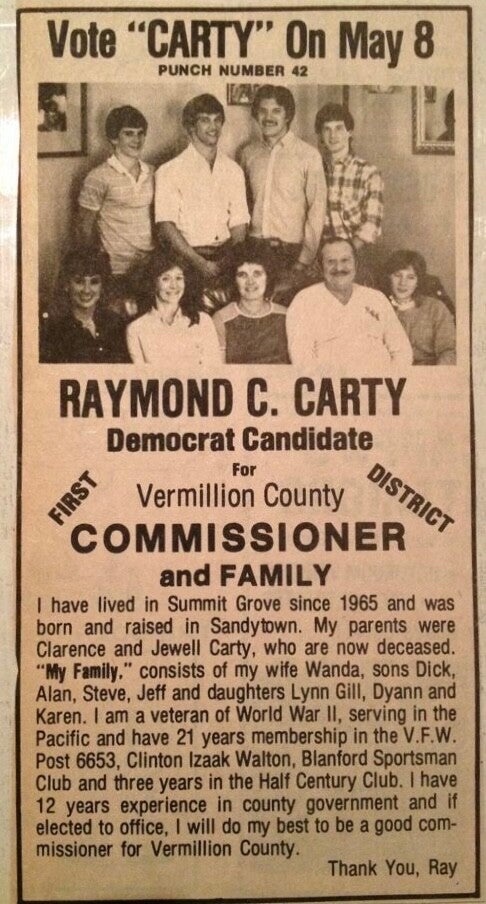
For his 1984 campaign ad, he wrote "My Family" consists of my wife Wanda, sons Dick, Alan, Steve, Jeff, and daughters Lynn Gill, Dyann, and Karen. I picture someone making air quotes and saying… “Oh, his ‘family!’”
In a letter he wrote to me in 1985, it said he was “At Work” and he signed off “Love” Dad. I always found this funny and often wonder if the quotation marks had any subliminal “meaning.” Probably not.
His PS said:
I AM NOT A HIGHSCHOOL GRADULATE?
S0 EXCUSE MY SPELLING
0K
"AT LEAST I WRIGT."
Maybe I got my yearning to write from him. Again, probably not.
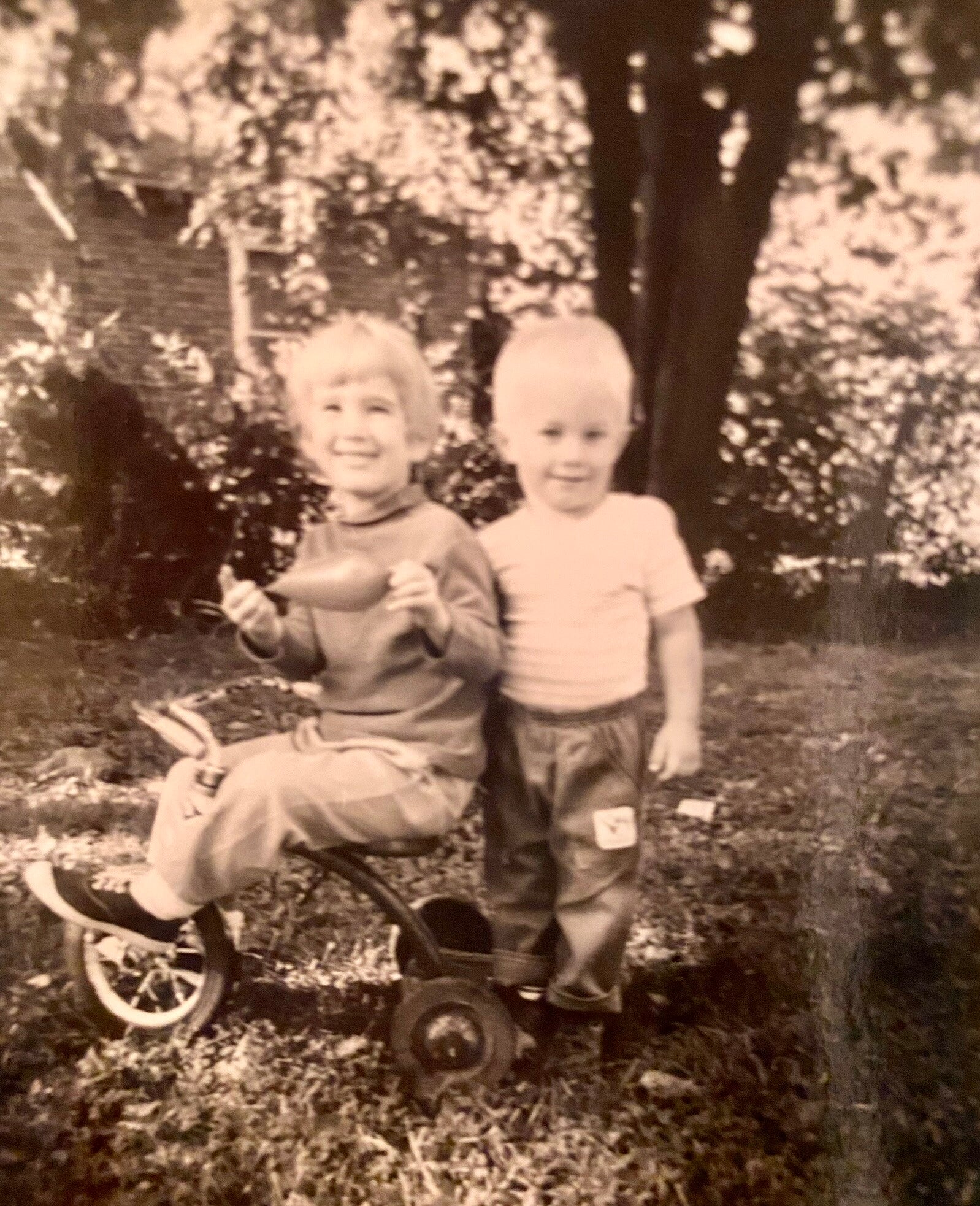
Alan and me in our yard in Centenary. circa 1964
Upcoming sneak peeks and essays... through my blog
I'm excited to announce some upcoming milestones for "Calling in 'The Family'." In the near future, I will be posting exclusive pictures and short essays directly on this blog. Some of these essays will be excerpts from the memoir itself, offering you a direct glimpse into its pages.
Others will be pieces inspired by my ongoing research and discoveries, providing additional context and stories that may or may not make it into the final manuscript.
These sneak peeks are designed to give you a deeper understanding of my memoir's themes and the personal journey I am taking in creating it.